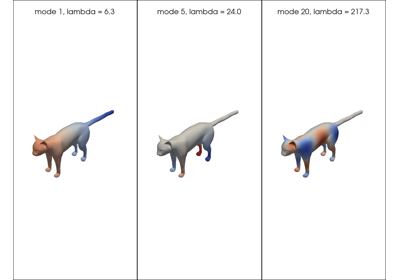
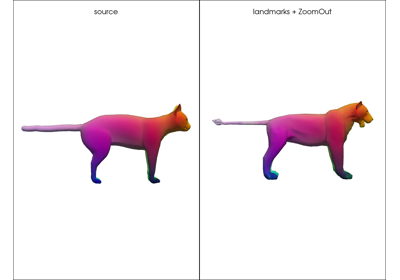
pyFM.functional.FunctionalMapping
- class pyFM.functional.FunctionalMapping(mesh1, mesh2)
Bases:
objectCompute a functional map between two meshes.
Typical workflow:
model = FunctionalMapping(mesh1, mesh2)
model.preprocess(descr_type='WKS')
model.fit(K=(50, 50))                # sets model.FM_12

p2p = model.get_p2p()                # from model.FM_12
FM_icp = model.icp_refine()
p2p_icp = model.get_p2p(FM_icp)
- FM_12
Functional map set by fit(). Refinement methods return a new FM rather than overwriting this one.
- Type:
(k2, k1) ndarray or None
- descr1, descr2
Descriptors set by preprocess().
- Type:
(n, p) ndarray or None
- property preprocessed
Deprecated alias for
has_spectral.
- project(func, k=None, mesh_ind=1)
Deprecated alias for
model.mesh1.project/model.mesh2.project.
- decode(coeffs, mesh_ind=2)
Deprecated alias for
model.mesh1.unproject/model.mesh2.unproject.
- get_p2p(FM=None, use_adj=False, n_jobs=None)
Compute a pointwise map from mesh2 to mesh1.
- Parameters:
- Returns:
p2p_21 – p2p_21[i] is the index on mesh1 corresponding to vertex i on mesh2.
- Return type:
(n2,) ndarray
- get_precise_map(FM=None, precompute_dmin=True, use_adj=True, batch_size=None, n_jobs=None, verbose=False)
Compute a precise (barycentric) map from mesh2 to mesh1.
See “Deblurring and Denoising of Maps between Shapes” (Ezuz & Ben-Chen).
- Parameters:
- Returns:
P21
- Return type:
(n2, n1) sparse matrix
- compute_spectral_descriptors(n_descr=100, descr_type='WKS', k_descr=128, landmarks=None, landmarks_only=False, subsample_step=1, normalization='l2')
Compute the LBO spectrum and descriptors needed for fit().
- Parameters:
n_descr (int) – Number of descriptor values per mesh.
descr_type ("WKS" | "HKS" | None) – Built-in descriptor type. Pass None to skip descriptor computation and supply descriptors manually via add_descriptors().
landmarks ((p,) or (p, 2) ndarray, optional) – Landmark indices. Shape (p,) uses the same indices on both meshes; shape (p, 2) uses column 0 for mesh1 and column 1 for mesh2.
landmarks_only (bool) – If True, compute descriptors only at the landmark vertices.
subsample_step (int) – Keep every nth descriptor column.
k_descr (int, optional) – Number of eigenvalues to compute for descriptor computation (default 128).
verbose (bool)
- preprocess(n_descr=100, descr_type='WKS', landmarks=None, landmarks_only=False, subsample_step=1, k_process=200, k_descr=128, verbose=False, K=None)
Compute the LBO spectrum and descriptors needed for fit().
- Parameters:
n_descr (int) – Number of descriptor values per mesh.
descr_type ("WKS" | "HKS" | None) – Built-in descriptor type. Pass None to skip descriptor computation and supply descriptors manually via add_descriptors().
landmarks ((p,) or (p, 2) ndarray, optional) – Landmark indices. Shape (p,) uses the same indices on both meshes; shape (p, 2) uses column 0 for mesh1 and column 1 for mesh2.
subsample_step (int) – Keep every nth descriptor column.
k_process (int, optional) – Number of eigenvalues to compute (default 200).
verbose (bool)
K (int or (int, int), optional) – Deprecated. The functional map size is now set on
fit().
- add_descriptors(descr1, descr2, normalize=True)
Append custom descriptors for both meshes.
Can be called after preprocess() to mix custom descriptors with built-in ones, or after preprocess(descr_type=None) for a fully custom descriptor workflow.
- Parameters:
descr1 ((n1, p) or (n1,) ndarray)
descr2 ((n2, p) or (n2,) ndarray)
normalize (bool) – L2-normalize each descriptor column using the mesh area metric.
- Return type:
self
- fit(K=(50, 50), w_descr=0.1, w_lap=0.001, w_dcomm=1, w_orient=0, orient_reversing=False, use_resolvent_laplacian=True, resolvent_gamma=0.5, optinit='zeros', factr=10000000.0, pgtol=1e-05, normalize_weights=True, verbose=False)
Solve the functional map optimization and store the result in self.FM_12.
Minimises:
  w_descr  * ||C A - B||²
+ w_lap    * ||C L1 - L2 C||²        (LBO commutativity)
+ w_dcomm  * Σ_i ||C D_Ai - D_Bi C||²  (descriptor commutativity)
+ w_orient * Σ_i ||C G_Ai - G_Bi C||²  (orientation term)
Only the ratios of the weights matter: they are normalized internally, so multiplying all of them by a common factor leaves the result unchanged.
Calls preprocess() automatically if it has not been done yet.
- Parameters:
w_descr (float)
w_lap (float)
w_dcomm (float)
w_orient (float) – Relative weight of the orientation term, rescaled internally so that w_orient=1 makes it comparable to the sum of the other terms at C=I. Set to 0 to disable it.
orient_reversing (bool) – Use orientation-reversing instead of orientation-preserving operators.
optinit ("zeros" | "identity" | "random")
factr (float) – L-BFGS-B relative tolerance on the energy decrease. Lower it (e.g. 1e2) for a tighter solve.
pgtol (float) – L-BFGS-B tolerance on the max-norm of the projected gradient. This test is absolute, so lower it if the energy is small in absolute terms.
verbose (bool)
- icp_refine(FM=None, nit=10, tol=1e-10, use_adj=False, n_jobs=None, verbose=False)
Refine a functional map with ICP.
- zoomout_refine(FM=None, nit=10, step=1, subsample=None, verbose=False)
Refine a functional map with ZoomOut.
- Parameters:
- Returns:
FM_zo
- Return type:
(k2 + nit*step, k1 + nit*step) ndarray
- compute_SD()
Compute area- and conformal-based shape difference operators. Stores results in self.SD_a and self.SD_c.
- transfer(func)
Transfer a function between meshes (project → transport → decode).
- Parameters:
func ((n1, p) ndarray)
- Returns:
transferred
- Return type:
(n2, p)